 LynnStrong writer
Stories
|
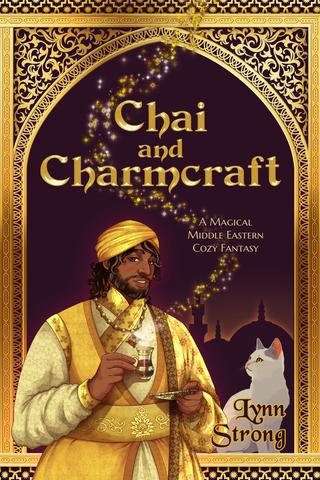
Chai and Charmcraft by Lynn Strong What’s a prince to do when his lover doesn’t want a crown and his cat-familiar is banned from the palace? His Imperial Highness Faraj al-Nadhir has never thought himself a charming sort of prince. He’s shy, round, middle-aged, and always dutiful. But he has also secretly spent years dreaming of a man tending jasmine in a sun-lit window — prophetic visions that led him at last to one blissful night with someone who sees his heart, not his crown. He did not expect to wake up with a cat walking on his face. Cat-familiars are forbidden in the Imperial fortress. They might be spies. They might be soul-charmers. They might even sharpen their claws on thousand-year-old tapestries. But Faraj cannot regret that sweet little Sahar chose him — just as he cannot regret Asharan bir Chameli, the enchanting owner of the House of Jasmines. Asharan wants nothing to do with Faraj’s title and power, only his kindness. And Faraj hadn’t expected either the delights or the dilemmas of Asharan’s magical, soft-pawed little gift. The rules have always been different for the God-Emperor's brother. Faraj never before realized how much. Now he's breakfasting from community cauldrons in back alleys full of children and kittens. His foresight shows him a thousand paths toward disaster, but not the way through. His devoted chamberlain fears that Faraj has been bewitched by a purring agent of chaos, and Faraj can’t exactly say he’s wrong. When the choice comes down to betraying his lover's name, his cat-familiar’s life, or his own use of forbidden magic, Faraj does the only thing he can: He gets himself put on trial for heresy, trying to change the laws of the Empire itself. If his visions always lead him into trouble, he might as well make useful trouble. Chai and Charmcraft is the first book in a cozy and queer Middle Eastern M/M fantasy trilogy brimming with charm, intrigue, later-in-life romance, body positivity, and so many kittens. Here, nobody needs a magical makeover to be loved exactly as they are — and their night of joy together isn't where the story ends. That's where it begins... |
|
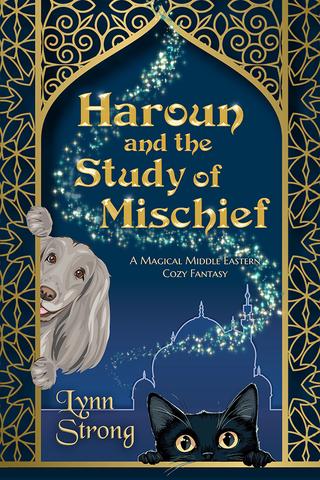
Haroun and the Study of Mischief by Lynn Strong “Don’t get a torch too close to his djellaba.” “It might catch fire?” “You might see it.” Venerable Haroun, the blind saluqi priest of the dog-headed god Yepuet, has come to the wild and collarless Tel-Bastet, the City of Cats, for an education in mischief. And Haroun has never met a crime of fashion he wouldn’t commit. Shai Madhur, the disabled human priest of Upaja, thought accepting Haroun’s leash meant being Haroun’s seeing-eye human. He wasn’t prepared for the political machinations… or for Haroun’s sense of humor. When a kind prophet-prince goes missing, Haroun smells iniquity in the air. (Iniquity, it turns out, smells like kumiss spilled on a tomcat in dire need of a bath.) The problem with everyone in Tel-Bastet knowing what a Good Boy their Shai Madhur is, is that people keep trying to rescue him, whether he needs it or not. Not that he’s complaining, exactly. But Madhur swears he is never going carousing again… no matter how soulful Haroun’s puppydog eyes are. With a splash of Studio Ghibli, a sprinkle of Roshani Chokshi, and a dash of Terry Pratchett, when the cats and dogs need to learn to live together, Haroun and Madhur take on the difference between what is seen and what is true. |
|
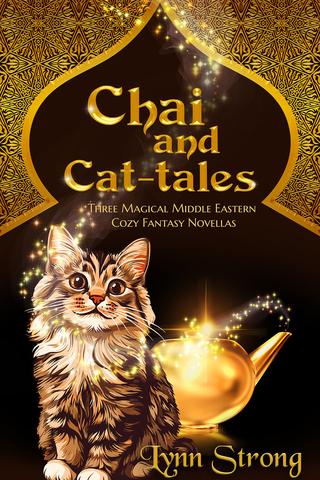
Chai and Cat-tales by Lynn Strong Bask in a sunbeam with three cozy fantasy novellas of the Catsprowl, a busy neighborhood brimming with cats and cat-goddesses, book-keepers and bath-houses, piping hot chai, and pouncing kittens' mischief. The Prince of Her Dreams Najra has three dreams in her life: First, catch the attention of a prince. (Specifically, the God-Emperor’s bookish youngest brother.) Next, get him to hire her to assist with his research in the marvelous Archives in Tel-Bastet. And then, at last, read ALL the books. Marrying the prince has never been in the plan. Najra has never lusted for anything but knowledge. Unfortunately, the prince has dreams as well. Because he's also a prophet who foresees trouble coming. Between her heretical geometries and her cursed spellbook, Najra has to admit that his dreams of trouble have her pegged. Now what is she supposed to do with a matchmaking busybody of an Archivist pushing them together, an angry catfolk bodyguard pulling them apart, and a sweet, anxious prophet-prince who won't even tell her what he wants? Priye For a small alley-kitten, human words make a tricky tangle of misunderstandings that bite back. Purring and hissing and yowling are much more clear. A human named her Priye, though, and he taught her that it means someone who is darling, someone who is treasured. Growing up in the nooks between three cultures is hard, but Priye wants to make her own way. And she wants to repay the kind people who feed small hungry kittens. But it's not always easy to hunt when everyone else is bigger and stronger and faster. The humans who named her like soap and water entirely too much. But maybe they have a point about sharing things instead of hunting things? The Potter's Dream Usually, the Temple of Bastet teems with cats and catfolk and cat-priestesses and cat-goddesses. It is not supposed to teem with mice. But kind-hearted priest Shai Madhur isn't very good at denying a nourishing meal to anybody… not even the mice. He needs a better mouse-catcher. But first, he needs to know where the shrine's cauldrons have gone. Because a potter has come to Shai Madhur's temple shrine, and the poor man looks hungry. What kind of priest can Shai Madhur be if he can't feed someone a nourishing meal? When he's sworn his life to serving others, and suddenly he has nothing at all to give, what does he have left? Sermons of acceptance are all well and good, but they don't fill an empty stomach. And there's something very strange about the potter. This book sets out to be cozy representation for folks who have been othered: brown folks, disabled folks, neurodiverse folks, ace and questioning folks, fat folks, diversely faithful, anyone who's wanted to see their othered selves welcomed and celebrated. |
